
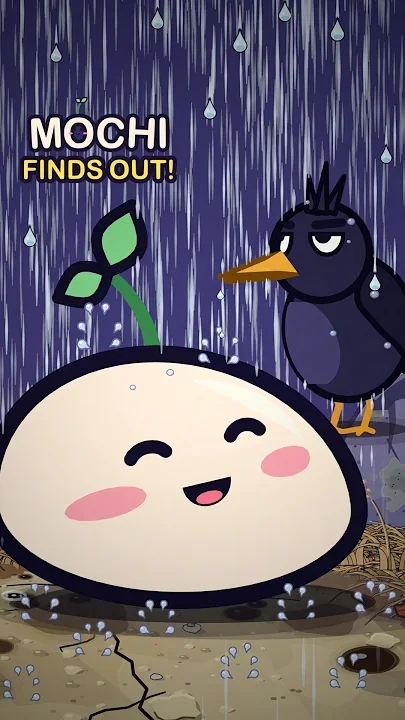

This Bear Hasn't Peed in 4 Months!
What Mochi found out
His pee goes back into his body.
A hibernating black bear can go up to seven months without eating, drinking, peeing or pooping. His bladder soaks his pee back into his blood, and his body breaks it down into building blocks that help keep his muscles strong. He has to: he’s living on his fat till spring, and fat can’t build muscle.
Real words
- bladder say “BLAD-er”
- The part of the body, low in the belly, where pee collects. A hibernating bear’s bladder soaks the pee back into his blood as fast as it comes in.
Who's in it
 MochiA curious little rice cake. She jumps in face-first to see things for herself.
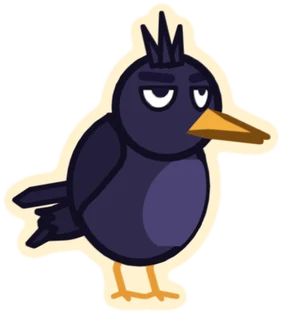 CrumbA crow who is very sure of himself, and not always right. He asks what you’re thinking.
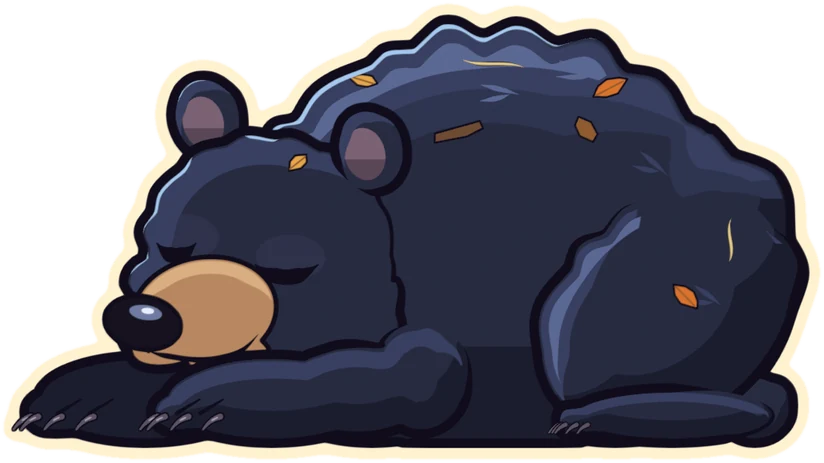 Black bearA big black bear, fast asleep in his winter den. He hasn’t peed in months, and Mochi’s shout only makes him stir.
Where the facts come from21
Every fact in this episode was checked against these on November 10, 2026.
- Tøien et al., 2011, Science 331:906
- Minnesota Department of Natural Resources, “Black bear”
- North American Bear Center, “5 stages of activity and hibernation”
- Florida Fish and Wildlife Conservation Commission, “Hibernation”
- North American Bear Center, “Do black bears hibernate?”
- Nelson et al., 1975, Mayo Clinic Proceedings 50:141
- University of Alaska Fairbanks, Alaska Science Forum, 1992, “Bothering a Sleeping Bear”
- National Park Service, Katmai, “Hibernation in Bears”
- University of Wyoming release on Harlow et al., 2001, Nature 409:997 (Newswise)
- Nakamura & Endo, 2026, Internal Medicine
- Lohuis et al., 2007, Comparative Biochemistry and Physiology B 147:20
- Fedorov et al., 2025, Ecology and Evolution
- National Park Service, Yellowstone, “Bear ecology”
- OpenStax, Anatomy and Physiology 2e, “2.5 Organic compounds essential to human functioning”
- Carey & Regan, 2022, The Conversation (republished by ScienceAlert)
- Laverty & Skadhauge, 2008, Comparative Biochemistry and Physiology A 149:246
- Comparative Biochemistry and Physiology A, 2005, English sparrow cecum (PubMed 15996497)
- Laske et al., 2010, Journal of Cardiovascular Translational Research 3:559
- Charles Darwin, 1872, The Expression of the Emotions in Man and Animals, chapter IV (Project Gutenberg #1227)
- North American Bear Center, “Winter dens”
- Virginia Department of Wildlife Resources, 2026, “Think you found a bear den? Please leave it alone” (press release)